
Last Updated: June 2026 — by EV-Wala Editorial Team
Published on EV-Wala | Updated June 2026
Quick note before we dive in: A lot of people call these “electric motorcycles” — they’re actually electric scooters. The Bajaj Chetak (named after Maharana Pratap’s legendary horse) is the iconic Indian scooter reborn as an EV. The TVS iQube is TVS Motor Company’s flagship electric scooter. No gears, no petrol, pure electric — and both are fighting for the same ₹1–1.7 lakh buyer.
So which one should you park outside your home in 2026? Let’s get real about this.
The Quick Verdict Box
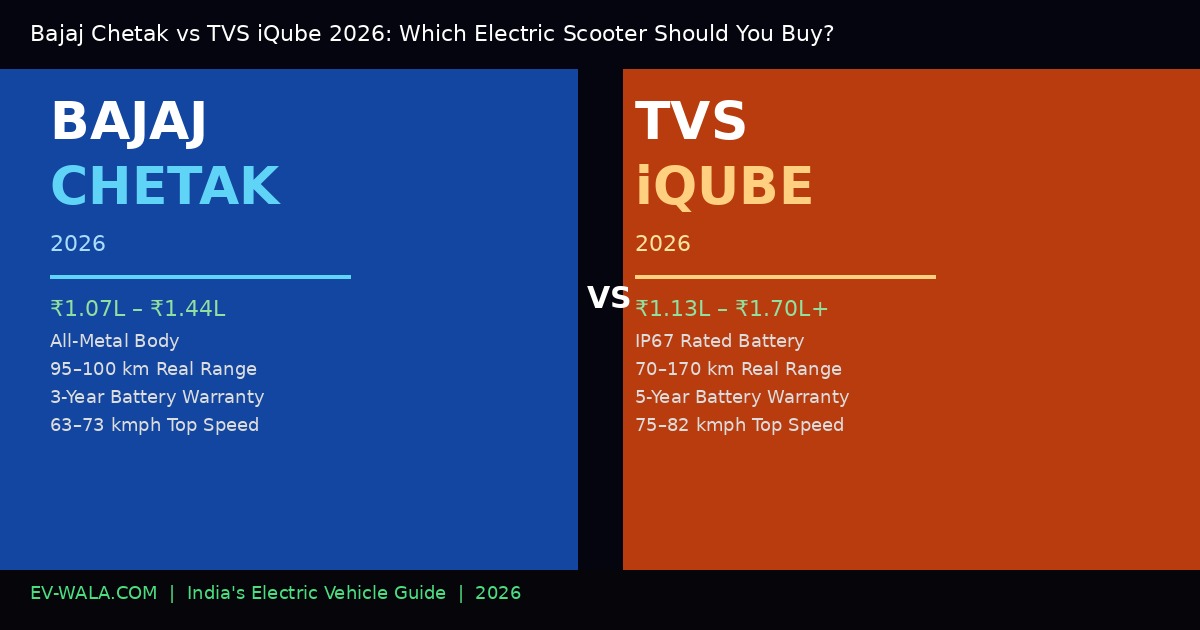
| 🔵 Bajaj Chetak | 🟠 TVS iQube | |
|---|---|---|
| Starting Price | ₹1.07L (3001) | ₹1.13L (2.2 kWh) |
| Best Mid-Range | ₹1.34L (C3502) | ₹1.35L (3.5 kWh) |
| Real-World Range | ~95–100 km | ~70–150 km (variant-dependent) |
| Top Speed | 63–73 kmph | 75–82 kmph |
| Body Material | All-Metal | Plastic (ABS) |
| Battery Warranty | 3 years | 5 years |
| Service Experience | Inconsistent | More reliable |
| Best For | Premium feel, city use | Performance, peace of mind |
Bajaj Chetak vs TVS iQube — Full Spec Comparison (2026)
| Spec | Bajaj Chetak | TVS iQube |
|---|---|---|
| Price (ex-showroom) | ₹1.07L – ₹1.44L | ₹1.13L – ₹1.85L |
| Real-world Range | 95–110 km | 70–170 km (variant-dependent) |
| Top Speed | 63–73 kmph | 75–82 kmph |
| Charging Time (0–80%) | ~3.5 hrs (15A home) | ~3 hrs (15A); fast charge on 4.7kWh+ |
| Battery | 2.9–3.2 kWh Li-ion | 2.2 / 3.5 / 4.7 / 5.3 kWh Li-ion (IP67) |
| Battery Warranty | 3 years | 5 years / 80,000 km |
| Build | All-metal body | ABS plastic panels |
| Service Network | ~750 EV-trained outlets | ~1,400+ outlets across India |
The full spec sheets we used here cross-reference manufacturer pages — the Bajaj Chetak official lineup and the TVS iQube official page — alongside ARAI-certified IDC range figures and real-world ownership data from Autocar India’s Bajaj Chetak Electric review. We’ve also weighted in commentary from Tier-2 owners in Nagpur, Indore, and Lucknow where service touchpoints differ noticeably from metro cities.
Bottom line: If you want a scooter that feels premium and you’re loyal to the Bajaj name, Chetak is satisfying. If you want a smarter long-term investment with better performance and warranty, iQube wins — especially the 3.5 kWh+ variants.
Let’s Start With What Actually Matters: Range
Both scooters claim impressive IDC ranges. But IDC (Indian Driving Cycle) numbers are tested in lab conditions. Your actual range will be lower.
Bajaj Chetak: The newer C3501 and C3502 claim 153 km. In real-world mixed riding? Expect 95–100 km. The team-bhp review of the related Chetak C25 found about 1% charge drop per km — so 95 km from 100% charge is realistic. That’s actually pretty decent for daily commuting.
TVS iQube: Depends heavily on which variant you pick.
– Base 2.2 kWh: ~70–75 km real-world (fine for short commutes)
– 3.5 kWh variants: ~100–115 km real-world
– ST 5.3 kWh: claimed 212 km IDC → real-world probably 150–170 km (though at highway speeds, range drops significantly)
For the typical city rider doing 30–50 km/day, both are fine. If you need 100+ km in a single charge, iQube’s mid-to-high variants are better suited.
The Metal vs Plastic Question
This is where things get emotional — and rightfully so.

The Bajaj Chetak has an all-metal body. Not plastic panels. Actual steel. This gives it a weight and solidity that you genuinely feel when you push down on the body panels. It doesn’t flex. It doesn’t rattle. In a country where scooters get bumped in parking lots daily, metal vs plastic is a real, functional difference.
“Iski solid metal body hai jo baaki plastic scooters se isko alag aur majboot banati hai.” — BikeDekho user (translation: “Its solid metal body is what makes it different and stronger than other plastic scooters.”)
The TVS iQube uses ABS plastic panels — same as virtually every modern scooter. TVS has done a good job with panel gaps and fit-finish, but it’s plastic. It will scratch, it will eventually fade, and a parking lot ding will leave a dent that looks worse on plastic than on dented metal.
Winner: Chetak, clearly. This is its biggest differentiator.
Performance: Speed, Pickup, Ride Modes
TVS iQube is the quicker scooter. The numbers don’t lie:
- Top speed: iQube hits 75–82 kmph (variant-dependent). The base Chetak 3001 tops out at just 63 kmph — which can feel limiting on faster city roads or expressway sections. The premium C3501/C3502 variants push this to 73 kmph.
- Torque: iQube delivers ~33 Nm vs Chetak’s 20 Nm. You feel this in city traffic — quicker pulls from 0-40, easier hill starts.
- Ride modes: iQube offers 3 modes (Eco/Power/Sport). Chetak has 2 (Eco/Sport). Minor but Sport mode on the iQube is noticeably peppier.
For Mumbai or Bangalore where you need quick acceleration to merge into traffic, iQube’s performance feels more natural. Chetak is smooth and refined, but it’s not a quick scooter.
Features & Tech: Both Are Good, iQube Goes Deeper
Both scooters come loaded with connectivity features in 2025-2026. Turn-by-turn navigation, Bluetooth app, geo-fencing, OTA updates, reverse mode, hill hold — it’s all there on both.
Chetak advantages:
– 35 litres under-seat storage (vs 32L on iQube) — this is actually a big deal for daily use
– Guide-me-home lamps, reverse light
– Cleaner instrument cluster on the base model
iQube advantages:
– SmartXonnect features are slightly more mature (crash alert, tow alert)
– IP67 battery (better water and dust protection — important in monsoons)
– Fast charging available on 4.7 kWh+ variants
– 7-inch TFT display on the S variant
Both scooters support smartphone connectivity and app-based monitoring. For most riders, the feature gap won’t matter day-to-day. But the IP67 battery rating on iQube is a genuine practical advantage in Indian weather conditions.
The Real Conversation: Service & Reliability
This is where the research gets uncomfortable — especially for Chetak fans.
Bajaj Chetak: A Pattern Worth Knowing
Multiple owners on team-bhp (India’s most credible automotive forum) reported serious issues in 2025:
Battery failure under 500 km: One owner wrote about their Chetak 3502 battery failing in under 500 km — describing it as “unreliable product, lack of accountability, and shockingly poor after-sales support.” (team-bhp, Oct 2025)
3,200 km ownership experience: Another team-bhp owner had ₹80,000 worth of parts replaced under warranty by the 3,200 km mark — and described service centres as overwhelmed, with vehicles waiting weeks for resolution. (team-bhp, Dec 2025)
“D Rated Battery” error: Some owners reported the scooter shutting down mid-traffic due to a battery error code. (team-bhp, Jul 2025)
A Reddit user who owns both scooters (r/EVsOfIndia, March 2026) put it bluntly: “Guys don’t purchase chetak at any cost… when the battery of chetak was giving issues… they said u have to wait for 2 months… you can see in their backyard a lot of ev chetaks waiting to solve their issues… go with tvs, their services r too good, sometimes in 4-5 hours they will solve your problem.”
And on BikeWale, owner Himanshu Mishra (purchased Nov 2025): “SOC 100 charge and range 82 km only and service centre no any solution.”
To Bajaj’s credit: one positive Reddit voice noted that under the extended warranty, Bajaj has proactively replaced whole batteries for affected owners. And the 3-year extended warranty covers battery, motor, charger, and display — that’s comprehensive.
TVS iQube: Better, But Not Perfect
iQube isn’t trouble-free either:
– One BikeWale reviewer’s battery died within 9 months/8,000 km — and TVS cited replacement battery shortage
– Reddit r/indianbikes documented a motor jamming at 16,600 km (covered under warranty)
– TVS has faced complaints of denying battery warranty on technicalities
But the overall community consensus is clear: TVS’s service experience is more consistent, faster, and less stressful than Bajaj’s Chetak service centres right now. TVS has more service touchpoints and better-trained EV technicians.
For most buyers, service experience > everything else. A scooter that spends weeks at the service centre is worse than a scooter with slightly less range.
Warranty Comparison (This One’s Important)
| Bajaj Chetak | TVS iQube | |
|---|---|---|
| Battery warranty | 3 years | 5 years / 80,000 km |
| Motor warranty | 3 years | 5 years |
| Vehicle warranty | 3 years unlimited km | 3 years |
iQube’s 5-year battery warranty is a 2-year advantage. For an EV where battery replacement can cost ₹30,000–60,000, this matters enormously. If your battery degrades significantly in year 4, TVS covers it. Bajaj doesn’t.
What Owners Are Actually Saying (Voice of Real Users)
Pro-Chetak:
“Good Electricity Bike for small trips… metal body gives good weight and stability… government subsidy still available.” — Manoranjan Panda, BikeWale (May 2026)
“Looks perfect and smooth to ride… the colour of the scooter is very attractive.” — Ranjith, BikeWale
Pro-iQube:
“The scooter has TVS’s best reliable build after Jupiter… powerful motor.” — BikeWale reviewer
“My dad has an iQube Standard which runs pretty well and lasts around 80-85km per charge.” — Reddit r/indianbikes
Critical-Chetak:
“After sale service is very bad… no solution… Range is very, very bad… tyre quality not good, software also not good!” — Rajesh Kumar, BikeWale
Critical-iQube:
“Battery dead within 9 months… replacement batteries not available with TVS company.” — Hiro Kewalramani, BikeWale
Price vs Value: Where Does the Money Make Sense?
Budget segment (₹1.07–1.30L ex-showroom):
- Chetak 3001 at ₹1.07L vs iQube 2.2 kWh at ₹1.13L
- Chetak wins here — metal body, decent 95km real-world range, strong brand recall, cheaper price
Mid-range (₹1.30–1.45L):
- Chetak C3502 at ₹1.34L vs iQube 3.5 kWh at ₹1.35L
- iQube edges ahead — better performance (82 kmph), same approximate range (100-115km real-world), superior warranty, IP67
Premium (₹1.50L+):
- Chetak C3501 at ₹1.44L vs iQube S 4.7 kWh at ₹1.58L+
- iQube pulls away — 175km range, fast charging, 5-yr warranty, 82 kmph; Chetak C3501 feels overpriced relative to what the iQube offers at similar money
The Recommendation
Choose Bajaj Chetak 3001 or C3503 if:
– Your daily commute is under 60 km
– You’re in a smaller city or town where Bajaj brand is trusted
– The metal body and premium feel genuinely matter to you
– Budget is tight and you’re buying at the ₹1.07–1.20L range
– You want the largest storage (35L) in class
Choose TVS iQube 3.5 kWh or above if:
– You’re commuting 50–100 km daily and want genuine range comfort
– Service quality and reliability matter more than aesthetics
– You want 75–82 kmph top speed for mixed city/highway use
– You value the 5-year battery warranty for long-term security
– You’re considering the ST 5.3 kWh for serious range (150+ km real-world)
The honest truth: At equivalent price points, the TVS iQube is the smarter rational choice in 2026. The Bajaj Chetak is the more emotionally satisfying one. India loves both — but if your scooter needs to work reliably for 5 years without drama, iQube has the edge.

FAQ — Bajaj Chetak vs TVS iQube
Q1: Which is better for daily commute, Chetak or iQube?
A: For a daily 30–50 km commute, both work — but the TVS iQube 3.5 kWh edges ahead because of its 82 kmph top speed and quicker pickup, which makes merging into Indian traffic less stressful. If your commute is under 25 km/day on quieter Tier-2/Tier-3 city roads (Nagpur, Indore, Lucknow), the Chetak 3001 is genuinely satisfying — and ₹6,000 cheaper. iQube wins on performance; Chetak wins on premium feel.
Q2: What’s the real-world range of Chetak vs iQube in Indian summer (40°C+)?
A: Heat hits EV range. In a 40–45°C Nagpur summer, the Chetak C3502 drops from a claimed 153 km IDC to roughly 85–95 km real-world. The iQube 3.5 kWh holds slightly better at 95–105 km — its IP67 battery thermal management is more mature. Park in shade, charge at night, and avoid Sport mode in peak heat — both will give you an extra 5–8 km.
Q3: Service network — which one wins in Tier-2 and Tier-3 cities?
A: TVS, hands down. TVS has roughly 1,400+ outlets and a longer history of training mechanics on EV systems. Bajaj has been expanding fast (~750 EV-ready outlets) but ownership reports from cities like Nagpur, Lucknow and Indore consistently flag long wait times and parts shortages on Chetak. If you live more than 30 km from a metro, default to iQube.
Q4: What’s the cost of ownership over 5 years?
A: Assuming 40 km/day, electricity at ₹8/unit, and basic servicing:
– Chetak C3502: ~₹1.34L purchase + ~₹18,000 electricity + ~₹15,000 service/consumables + likely ₹0 battery (under warranty for 3 yrs) = ~₹1.67L over 5 years. Risk: out-of-warranty battery in years 4–5.
– TVS iQube 3.5 kWh: ~₹1.35L purchase + ~₹16,000 electricity + ~₹14,000 service + ₹0 battery (5-yr warranty covers full term) = ~₹1.65L over 5 years.
iQube comes out marginally cheaper and far less risky thanks to the 2-year longer battery warranty.
Q5: Which is safer for monsoon riding?
A: Both are road-legal and IP-rated, but the TVS iQube has an IP67-rated battery pack (dust-tight + can withstand short submersion in 1m water for 30 min) — that’s the kind of hard spec that matters when you’re wading through 6 inches of water in Mumbai or Pune monsoons. Chetak’s battery is sealed but not officially IP67-certified. For monsoon-heavy regions, iQube is the safer pick. For both, never park under a tree in heavy rain and avoid charging with wet hands.
EV-Wala is your guide to India’s electric vehicle revolution. Have you owned a Chetak or iQube? Share your real experience in the comments — your review helps the next buyer.
🔋 Still comparing? Check out our Ather Rizta vs TVS iQube comparison and our best electric scooters under ₹1.5 lakh in 2026 roundup.
{ “@context”: “https://schema.org”, “@type”: “FAQPage”, “mainEntity”: [ {“@type”: “Question”,”name”: “Which is better for daily commute, Chetak or iQube?”,”acceptedAnswer”: {“@type”: “Answer”,”text”: “For a daily 30-50 km commute, both work but the TVS iQube 3.5 kWh edges ahead due to its 82 kmph top speed and quicker pickup. For under 25 km/day in quieter Tier-2/Tier-3 cities, the Chetak 3001 is satisfying and Rs 6,000 cheaper. iQube wins on performance, Chetak wins on premium feel.”}}, {“@type”: “Question”,”name”: “What is the real-world range of Chetak vs iQube in Indian summer above 40 degrees Celsius?”,”acceptedAnswer”: {“@type”: “Answer”,”text”: “In a 40-45 degree Celsius summer the Chetak C3502 drops from a claimed 153 km IDC to roughly 85-95 km real-world. The iQube 3.5 kWh holds slightly better at 95-105 km with its IP67 battery thermal management.”}}, {“@type”: “Question”,”name”: “Service network — which one wins in Tier-2 and Tier-3 cities?”,”acceptedAnswer”: {“@type”: “Answer”,”text”: “TVS wins. TVS has roughly 1,400+ outlets and longer history training mechanics on EV systems. Bajaj has 750 EV-ready outlets but ownership reports from Nagpur, Lucknow and Indore flag long wait times and parts shortages on Chetak.”}}, {“@type”: “Question”,”name”: “What is the cost of ownership over 5 years?”,”acceptedAnswer”: {“@type”: “Answer”,”text”: “At 40 km/day and electricity at Rs 8/unit, the Chetak C3502 totals about Rs 1.67L over 5 years and the TVS iQube 3.5 kWh about Rs 1.65L. iQube is marginally cheaper and lower-risk because of the 5-year battery warranty.”}}, {“@type”: “Question”,”name”: “Which is safer for monsoon riding?”,”acceptedAnswer”: {“@type”: “Answer”,”text”: “TVS iQube is safer in monsoon. It has an IP67-rated battery pack (dust-tight, can withstand 1m submersion for 30 minutes). Chetak battery is sealed but not officially IP67. For monsoon-heavy regions, iQube is the safer pick.”}} ] }